Blog

For A Good Vibe, Ride The “Reggae Bus”

Posted on: Wednesday, February 18th, 2009
Posted in: Travelog, 4th Stop: Grenada, Latest Trip | 3 comments
On the last island (Bequia), it was called the “Dollar Bus.”  Here, it costs about the same, and is sometimes called the “Reggae Bus.”  They are privately owned vans that run established routes, all across the island. They tend to be crowded but exceptionally polite.  And the drivers, just like in Bequia, are crazy.  But it’s a great ride, and great vibe.  Grenada is way laidback but with good energy.  Just check out some of these heartening bus names and messages…
 
  • Shining Light
  • No Hard Feelings
  • Yes Jah
  • Live On
  • Always Decent
  • Live Simply
  • Vision
  • No Stress
  • Faithfull
  • Vibes
  • Stamina
  • Sweet Heart
  • 100% Grenadian
  • Life Nice
  • Unity
  • Conscious
  • Good People
  • Just Simple
  • Blessings
  • Love is the Answer
  • New Beginning
  • Higher Level
  • Next Level
  • Jus Level
  • Chilaxin
  • Bless Up
 
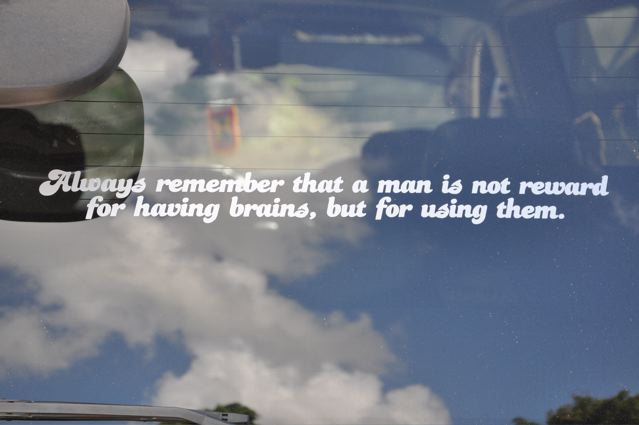
And on the back window, many owners create customized communiqués for all to see…
 
  • The sky is wide enough for a million stars.
  • Who feels it knows it. 
  • Rise to action.
  • Positive feeling.
  • Follow righteousness.
  • God is Love.
  • All Friends, No Enemies.
  • All Right!
  • You will never fail until you stop trying.
  • Jah have a blessing for you.
dsc_0005

The Great Caribbean Beer-Off!

Posted on: Tuesday, February 17th, 2009
Posted in: Travelog, 4th Stop: Grenada, Latest Trip | 6 comments
Beer tastes better down here (if that’s possible). It goes well with seafood, sailing, sunning, and as a palate (and/or body) cleanser for the salt after swimming. While all beer is good food, a few barely pass the smell test. So please open your palate, mouth, and mind. It’s time for the Great Caribbean Beer-off!
 
AND THE WINNER IS…STAG! 
 
HERE ARE THE FINAL RESULTS… based on ratings in 10 categories worth 10 points each—possible 100 points.
1st Place:  Stag, 85 points
2nd Place:  Heineken, 70 points
3rd Place:  Hairoun, 69 points
4th Place:  Carib, 55 points
3281493414_cbe4dc42a11
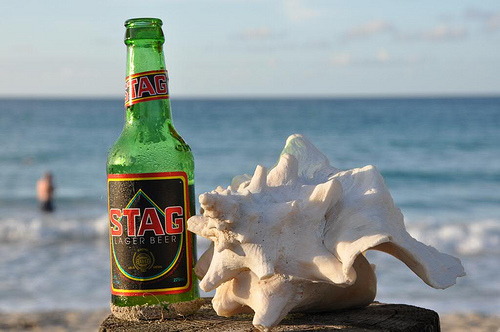
  • 1st Place:  STAG  (pronounced:  STOG!)
Name:  8.  A bit tacky, but easy to say after you’ve had a few.  Unique.  Macho. 
Story:  7.  Supposedly from Trinidad, a place that makes most people agog and afraid. 
Marketing:  10.  Virtually none—a dark horse.  How cool is that?  Like a private club. 
Smell Test:  8.  Smells pretty okay, for a beer. 
Taste:  10.  Once drinkers discover it, they stick with it. 
Availability:  7.  Pretty common in the southern islands, but nowhere north.  Exclusivity brings bonding? 
Tepidity:  9.  Stands up to the sun, if necessary.  Your best bet when cold can’t be found. 
Size Matters:  7.  Usually in large bottles.  But occasionally a bar fools you with smalls. 
Price:  9.  More than Carib, but much less than Heinie.   
Bonus:  10.  What’s not to love? 

dscn1286_2
  • 2nd Place: HEINEKEN  (pronounced:  I-nuh-KEN!)
Name:  8.  Comfortable, familiar, ever-cool.  It’s the International Budweiser.  
Story:  8.  Comes from Holland, or whatever they’re called now.  They need attention. 
Marketing:  9.  Always classy and calming  Love that little red star. 
Smell Test:  4.  Smells skunky, if in a good way.  An acquired scent. 
Taste:  9.  Bottled all over, yet eternally consistent.  Effervescent, welcome mouthfeel. 
Availability:  10.  If any Caribbean joint has only 2 beers, one will be Heinie. 
Tepidity:  6.  Not good warm, but it disappears fast, so… 
Size Matters:  6.  Bad:  usually comes in mini-bottles (250 ml).  Good:  cute little cans. 
Price:  5.  Costs more for less liquid.  Ish! 
Bonus:  8.  Like and old friend.  Plus you look Euro and suave, if you wish. 
 
Our Island, Our Beer
  • 3rd Place:  HAIROUN (pronounced:  I-ROON!)
Name:  7.  Fun to say.  You sound local once you get it right.  Odd spelling, though. 
Story:  10. What St. Vincent used to be called, so big ups for nostalgia and stubbornness.
Marketing:  9.  Vincies love their homegrown.  “Our Island, Our Beer.”  Whoa! 
Smell Test:  5.  Could be worse. 
Taste:  7.  Goes down easy.  No problem, mon. 
Availability:  3.  Unheard of after you leave the SV Grenadines.  Withdrawal risk. 
Tepidity:  5.  No loitering.  Great ice-cold, but the warmer it gets, the more it sucks. 
Size Matters:  9.  Only seen it in 12 ounce bottles.  But never on tap loses a point. 
Price:  7.  Cheaper than Heineken, but not cheap enough.  
Bonus:  7.  Didn’t get tired of it for several weeks.  Great memories. 

Carib:  Worst Caribbean Beer?
  • 4th Place:  CARIB  (pronounced:  CA-RIB)
Name:  9.  Almost Caribbean.  Named after fearless, feral Indian settlers. 
Story:  5.  Not much “there” there.  Brewed in many ports, with many ? waters. 
Marketing:  5.  Little to see beyond omnipresent personal endorsements. 
Smell Test:  3.  Smells so bad it’s often served with a lime. 
Taste:  3.  Kinda Corona-like, maybe worse.  Watery, wimpy colon-cleanser.   
Availability:  6.  Mostly avails S of the N/S Grenadian meridian; occasionally N. 
Tepidity:  1.  Not good cold, worse warm.  Must be ice-cold and pounded carelessly.   
Size Matters:  6.  Good: only comes in large units.  Bad:  only comes in large units. 
Price:  10.  Cheapcheap.  + sold where people party by renegades at miniscule markups.   
Bonus:  7.  Good: often served w/ lime; can be on tap.  Bad:  On tap can be flat & insipid. 
 

Island Learning: Keeping it Local

Posted on: Friday, February 13th, 2009
Posted in: Work/Life Hacking, Blog | One comment

Kids pick up a lot by experience and osmosis. But picking up books along the way perks up their sense of place—and increases their vernacular vocabulary. Wandering in little island book stores is a treat, too. The better ones do a fine job of providing local lesson materials, and make book browsing fun. 

Here’s just some of the stuff we’ve stumbled on that even the parents can appreciate…

3270750654_e5ac2a9959

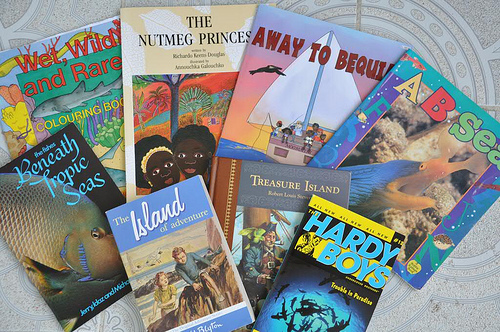
  • Children’s Stories.  Often written with some dialect and new words, they bring a child’s perspective to the big, old world.  “Away to Bequia” takes a quirky family sailing from St. Vincent to little Bequia.  “The Nutmeg Princess” features three haunting, local legends that make CurlyGirl’s blue eyes go wide open. 
  • Adventures.  AllBoy devours anything with some suspense and sea drama.  An adapted version of “Treasure Island” made him love a book his dad has never finished, while a Hardy Boys saga set on St. John brought new drama to familiar sites. 
  • Reference sources.  Fortunately, the better places you stay have stacks of guidebooks, nature books, maps, atlases, and more.  We thumb through those, plus pick up the likes of “A B Sea” for the little one and “Beneath Tropic Seas” for the tween.
  • Art materials.  Just handing out paper and pens to the kids brings forth some impressive interpretations of fish, plants, and local colors.  A coloring book like “Wet, Wild and Rare” not only provides fun drawings, but brief copy about the wildlife (non-human) of the Caribbean. 
  • Music.  Ears getting filled with song is the most ongoing and obvious proof that we’re far away.  It’s everywhere, all the time.  And although there is surprising variety, most of it is island-centric.  We pay attention in the buses and stores, go to hear it live, buy CDs, and even make our own with guitar and riddim instruments. 

A Tale of 2 Offers

Posted on: Wednesday, February 11th, 2009
Posted in: HR FYI, Blog | Leave a comment
The recession in England rages on, and Sabbaticals continue to make headlines at major newspapers as companies create new ways to keep trained workers, yet cut costs.  At KPMG, a heavy-hitter accounting firm, 69% of the firm’s 11,000 partners have volunteered to take a Sabbatical or work four days a week, both at reduced pay.  In labor-intensive Jaguar Land Rover, the opposite is happening:  Only 15 of 2,200 workers at the Vauxhall plant offered time off with 80% pay have signed up. 
 
KPMG keeps sweetening the pot, which no doubt is helping draw get more takers.  They’re now aiming for 75% participation.  Wow. 
 
Meanwhile, at Jaguar Land Rover, where employees can make 80% of their salary not to work for a while, the enthusiasm for the offer is negligible.  One employee sums it up this way,
“I’d rather be at work doing nothing than sitting at home spending money.” 
 
What’s going on here?  Let’s offer a few speculations…

  • KPMG partners probably have more savings—and feel more secure about their eventual futures because of more experience and education. 
  • KPMG employees likely don’t have a union, and thus work longer hours and more days, and may know burnout better and thus welcome time off. 
  • KPMG folks may feel more loyal toward their company, having endured less change of late—and having obtained the coveted “partner” status. 
  • Auto workers may fear their jobs just won’t be waiting for them, especially since Jaguar Land Rover is now owned by an Asian company that could gradually shift manufacturing to cheaper overseas plants. 
  • Auto workers could suspect that their jobs are better, and better paying, than the positions they might end up in if they are terminated. 
  • Jaguar Land Rover laborers have probably lived with lower salaries, and may not have much savings; in fact, they may be in debt situations where not working for 80% of their salary simply would not meet the debt load.
This tale of two offers suggests that the chasm between professional and labor is deeper than ever.  Scary times like these are hard on families, employee morale, and whole nations.
Kudos to KPMG and their partners for finding the courage to BreakAway from stability and leap into the some freedom, albeit with many asterixes attached.  Let’s hope some of the good people at Jaguar Land Rover find way to take the time, yet keep their larger lives intact. 
 

NYT Talks Grenada & I Talk Back

Posted on: Monday, February 9th, 2009
Posted in: Travelog, 4th Stop: Grenada, Latest Trip | 3 comments
On Saturday, February 7, the New York Times published a lengthy and insightful travel article, “In Grenada, Leaving the Past Behind,” by Ned Martel.  After digging into Grenada for the past 2+ weeks (and exploring the West Indies for nearly two months) I must say he’s mostly spot-on.  Yet a “conversation” with this big-time write-up is too tempting to pass up.  First, his quotes; then my replies…

3260518568_bfcc5510d0
Leaving the past behind…”  
Yes, they’re working on building a brighter future.  But the past is omnipresent too, in ongoing hurricane repairs, print, street paintings, and conversations. In a bar where I killed an hour today, four locals debated 1974 and 1979 events the entire time.  Who in America can discuss politics circa the 70s? And would 95% of Americans wear the national colors the whole weekend during Independence celebrations?  No way.      
What I get is the feeling that folks are happy to see me, even if they see me on occasion as a human dollar sign.”  
True dat!  But folks here may have mastered the art of be happy, don’t worry.  And a dollar can buy a lot of happy down here.  An EC buck costs about US$.40, and seems more appreciated than in typical tourist economies—maybe because tourists are still rare on most of the island.  Mercifully, guests are rarely “horossed.”  What I’ve more noted is the generosity:  I couldn’t quantify the poundage of perfect produce that’s been cheerfully given to us.  And in Grenville, a kind vegetable vendor gifted my children two bags of cheesy chips after I’d refused to buy them.  She wins, my kids win, I smile and wag my finger at her coy smirk.  
The intervention.”  
Guidebooks may have clued me in.  But I’ve heard it called everything from “the invasion” to “the intervention” to “the liberation.”  Of course, politics run thicker than callaloo stew down here; I’ve seen people this weekend (their Independence Day) wearing Bishop t-shirts.  He was the one assassinated in ’83, shortly before “the intervention.” 
Islanders have savored relaxation so heartily…”  
No exaggeration:  I hear that word used many times a day by locals.  Like a mantra.  Not only are they selling it, they’re practicing the discipline themselves.  Loitering. Chilling. Hanging out. Grenadians have made it an art form.  They also say “rest” a lot.  If you ask if that’s the restaurant owner sitting at a corner table alone, they’ll just say, “Ya mon, he restin’.”  Nobody would question it if he sat there all night.  
An air of gratitude that suggests they couldn’t have enjoyed the freedoms of today without the despairs of yesterday.”  
Indeed, freedom rules.  Yet the customs and manners here are eerily old school, the people reverent and demure.  Not only do they say thank you, they always say you’re welcome.  As for the mentioned despairs, my guess is a gutsy, national pride has grown from all they’ve been through:  slavery, revolution, US invasion, huge hurricanes.  They work hard and take little for granted, including the fruits of their labor and the ease of feeling free.        
We stop half a dozen times.  
Yep.  At least.  Mr. Welcome Cummings is obviously a classy, high-end driver.  We’ve used recommended renegade drivers, who charge less but don’t have a taxi license, AC, or seatbelts, and who will stop dozens of times.  In the middle of the road.  The authenticity is priceless, and we meet local folks and gain instant insight into real-life Grenada.  Cell phones may be common, but Grenadians still communicate in person and on the move. 
More hypocrisy in the churches than in the rum shops.”  
Ha!  Perhaps, but there’s more macho, booming BS in the rum shops than all the churches combined.  Grenada is uncannily spiritual.  “All family belongs to a church,” I was told yesterday.  “Even the Roman Catholic dance in the aisles,” I was told today.  People paint inspirational messages—not graffiti—all over.  The public-transportation “reggae buses” have names like “Bless Up,” “Always Decent,” and “Yes Jah.”  The back windshield will boast verses as simple as, “God is Love” to “The sky is wide enough for a million stars.”  Like billboards in an American city, you can’t escape these messages—of positivity and faith.    
From the hilltop jail, convicts enjoy the best view of the island.”  
For real.  Methinks they could convert that hoosegow with a view into a chic S&M resort called “Incarceration,” except this conservative island has a dress code and doesn’t even allow cleavage (never mind that men carry knives and machetes).  The harborside hospital also has a stunning location, and has the rep of being full of new equipment—that no one knows how to use.  That, too, could make a nice fantasy resort…for wealthy hypochondriacs?
I could spend all night at Patrick’s, and with Patrick himself.”   

Put simply:  We had the exact opposite experience.  The worst night, worst food, worst encounter with a Grenadian.  Maybe it’s because I don’t write for The Times?  Or perhaps it was just fate. It matters not.  Travel teaches us that bliss comes in 555 forms.  And letdowns happen.  Even his waitress couldn’t handle Patrick that night, and our cabbie (nobody special) was embarrassed upon hearing our story.  We were the only table in the joint that evening.  But were also told that the previous night had been packed with naughty yachties.  Hmmm.  I’m glad the NYT writer had a good experience; that gives me simultaneous skepticism, hope, and—maybe—a reason to try again.

…endure a lot of stares and the occasional shout of ‘White man!’ even as I sit safely in One Dog’s passenger seat.”  
Yep.  My posse is a white man, woman, boy, and girl—all Scandinavian blonde and blue.  Been there, heard that–though we may have looked less “outsider” when traveling in the rusty jalopies of locals.  I prefer to think that we were novelties, not targets.  You know, like a donkey in the Mall of America, where everyone would no doubt yell, “Donkey!”  
We reach a spooky town…  
For sure, if you tour the many neighbohorhoods, villages and towns of Grenada, at least one will strike you as spooky.  Or your driver will tell you it is.  Or a “local lunatic” or “half-brained crackhead” will come at your car.  Spooky, or just predictable island drama?  Still, the worst vibe I felt and mischief I saw was PG compared to a drive through many ‘hoods in Minneapolis.  For fear management, I’ll take Grenada.  (Yet that cemetery at Carib Leap in Sauteurs was sorta creepy…) 
Obama!”  
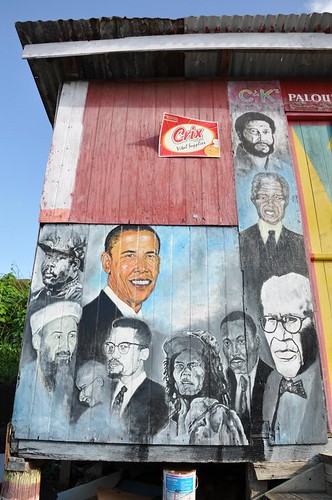
For now, Americans are cool.  The Caribbean glows with the pride that the USA chose a Black man to be president.  His face appears on bumper stickers, gallery artworks, and roadside paintings—where he sitteth alongside the likes of Bob Marley, Nelson Mandela, MLK, and Fidel Castro.  
DSC_0239
  • In conclusion:  Great story, Ned.  Come back before February ends, and we’ll compare notes and local rums–on me.  And just for some extra theater, let’s have our last supper at Patrick’s. 
 

BreakAway Heroes Sail in from France

Posted on: Wednesday, February 4th, 2009
Posted in: Work/Life Hacking, Blog | 5 comments
So I have this Big Idea—about retiring now and then instead of waiting until your final years, even if it means working longer at the end or enacting some sacrifices along the way. But just when I’m feeling pretty smug about taking 4 Sabbaticals in 19 years, along come some real experts, my new heroes, this intrepid family from France.
              

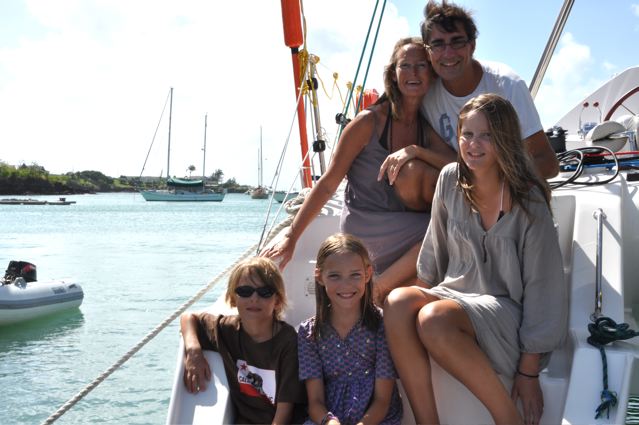
Frank, France, Juliette, Jeanne & Colin, Lifehackers extraordinaire

Frank, France, Juliette, Jeanne & Colin, Lifehackers extraordinaire

My idea is hardly original.  And folks like this prove that advanced actualization is possible.  You see, they are in the middle of executing the unthinkable:  Taking one year to sail; including to and from Europe; while home-schooling their 3 children via a vigorous program; and leaving a 100-employee business behind in the mist. 
 
Truth is, we’ve met many Euro-families doing this—from Sweden, the Netherlands, and beyond.  You see their flags flying and hear their children playing on vessels throughout the islands.  But we connected for a lovely, long time with these good people. 
 
They were living on their sailboat in the harbor of our resort when we arrived.  Our children soon found each other, we started sharing meals, and spent many hours relaxing and chatting with them—from which I assemble this collage of quotes, courtesy of Frank and France, with ongoing validation from their children, Colin, Jeanne & Juliette (ages 6, 10, 12).
 
It Starts with a Dream
At first it was just my dream, but then it got shared by the whole family.  I wanted to show the kids that if you have a dream, it takes time—year after year.  It’s important to keep it, even if you’re not realizing it.  But if you want it bad enough, and work hard, you can usually achieve most of your goals. 
 
My dream was a big sail.  I’ve had it for 20 years.  The family became part of it 10 years ago, because we had children.  5 years ago, I made it a real project.  And three years ago, I told my business partner and company we need to make this possible.  To not disturb the company was important.  And yet, my customers were actually impressed, not upset. 
 
I made a deal with my partner:  I do this, and you can also have a year off to use however you wish.  He still has that to look forward to. 
 
Workaholism Became Big Motivator
I work a lot.  The average week is 60 hours, I’d say.  A big awakening moment for me was realizing that I’d almost missed the births of two out of my three children.  I realized:  These are the big occasions of your life.  You have to be there.  They won’t happen again.  I decided if I wanted to see my children grow up, it was time to recalibrate my priorities. 

Getting the Children on Board
The timing was based largely on the children.  We figured that our oldest, 12, would be harder to remove from her social life at 13 or 14.  During planning, she did think a year would be too long.  But now that we are doing it, she keeps asking if we can keep sailing for another year! 
 
We had to convince them that this was our big chance for time together.  For exciting exploration—which I think is more important than school. 
 
The transition was difficult for all of us.  Being on a boat 24/7 with no escapes, well, sometimes that led to big explosions.  It’s easier now.  We’ve found ways to give free space and time.  Navigating.  Photos.  Art and play.  We all work on a website about the trip.  And of course, home schooling eats up a lot of time. 

Home Schooling a la France:  All Hands on Deck! 
As French citizens, to leave for a year, we MUST educate our children through a program called Centre Nationalee D’Enseignement a’ Distance.  There are 200,000 French students all over the world!  It goes as high as Ph.D.  We are registered to two different schools.  We belong to classes with teachers.  It’s very challenging and administrative. 
 
There are many, many books and supplies on board.  We have to do things like record music lessons on cassette and send it to France.  There, a teacher listens, records comments, and sends it back.  They even expect us to do chemistry experiments!  We’ve gotten bad grades and been scolded in e-mails for being late.  It’s taken much more time and focus than we expected, but we keep at it and do our best. 

Setting Sail on an Ambitious Adventure
The nice thing about life on a boat is that you can go anywhere.  It’s like having a move-able house on water.  We started from France, of course, and have done stops in Spain, the Canary Islands, Senegal, the Capo Verde islands, Barbados, the Grenadines, and Bequia.  We’ll spend some serious time in the French-Caribbean islands and Cuba before crossing the Atlantic to go home again. 
 
As for rough moments—besides privacy and home schooling.  We did have a medical emergency while crossing in September.  For a few hours, it was very scary.  One daughter got seriously ill, with many symptoms, and we thought it might be appendicitis.  That would NOT be easy to handle alone in stormy seas. 
 
Another terrible moment was going through customs on one particular island.  We made a simple mistake:  We had a friend on board—who had helped us cross over.  We arrived late, after customs was closed, and he had an early flight out the next morning, so we didn’t declare him.  Bad idea.  Customs figured that out and five agents surrounded, shouted, and grilled me for thirty minutes, like a scene from Midnight Express.
 
They told me the penalty is $5,000, one year in prison, or both.  Somehow, I kept my cool.  And they eventually backed off.  The calendar helped save me because, in the end, they said, “You’re lucky tomorrow is Christmas and we’re closed, so we’re going to drop the whole matter.”  That is NOT a good memory, though. 

Soon Comes the Hard Part:  Return to Reality
First came planning, and then the trip itself.  But the part that may be most difficult is going home.  We get back in July and school begins in September.  So for the kids, that transition will probably be easier.  But some of their friends may have moved on, so there could be other issues. 
 
I fear going back to work, I guess.  What if people have taken on too much autonomy and won’t listen to me any more?  I may have to refocus some people, or even ask if the company still needs me at all.  And my partner and I will need to learn to work together again after all this time and change. 
 
I don’t look forward to the weather, of course.  Where we live in France has a long, gray winter.  Would you believe I prefer this beautiful tropical season? 
 
  • But more than anything, I worry about ennui—being bored.  After a dream-come-true like this, will routine and work feel worthwhile and satisfying?  We will see. Perhaps to start thinking about the next big dream will be one way to survive the transition…

Thanks for the reminder.  Our Sabbatical ends months before you sail back across the big pond. So yes, it’s time to savor every setting, prepare for the impending re-entry, and start working toward the next big BreakAway.

Cool Breezes Bless Annual Sailing Festival

Posted on: Sunday, February 1st, 2009
Posted in: Travelog, 4th Stop: Grenada, Latest Trip | 3 comments

What a glorious Sunday!  Days like this—exactly like this—float like fantasies in the mind when one is plotting a BreakAway.  So when they finally happen, the pleasure feels both familiar and profound.

3252523445_ed1d9df1dc

Grenada’s sailing festival is a big event, running over several days, with yachties from all over the world filling the harbors, hotels, and bars. That’s fun.  And in our resort, it was easy to make new friends.  Heck, a team from the Shetland Isles of Scotland invited me to join their team for two races.  Unfortunately, the timing didn’t work out. Dang!

The Finish Line

But the real action—at least for the locals—is the “work boat” races on Grand Anse beach.  These are traditional, home-made boats, with plywood for the body, bamboo for the mast, and sponsor-donated sailcloth for the one mainsail.

The towns and outer islands (Petit Martinique and Carriacou) race each other, and yes, there is rivalry!  The race begins on shore with a LeMans-style start, heads out to sea for three turns around buoys, and then returns to shore again.  When the boat hits sand, and a sailor scrambles out and crosses the finish line–and runs to the stand for a shot of rum–we have a winner.

Run for the Rum!

The festival features all the sights, sounds, and smells that make events like these so sweet…

  • An MC sets the stage and keeps things moving and dancing; his subwoofer is the size of an SUV and keeps all three miles of the beach bobbing in riddim.
  • There are junior races (sorry, no rum for you), so the families can get giddy and noisy.

Future Sailor

  • There are rivalries, sure, but also times when a whole team goes missing and the race gets delayed.

Strategy Session

  • The occasional “man overboard” makes for lots of excitement, as the waterlogged sailor swims as quickly as he can to catch up with his craft.
  • Kids play in the sand and swim right around the start and finish lines and couldn’t care less about no races.

Time for a Swim

  • Vendors line the beach selling bbq, oildown (the national dish), souvenirs, hand-made crafts, cold bevies, and lots and lots of beer.
  • Young men gather in groups under seagrape trees to catch a buzz and be cool.

Run from the Big Boys

  • Pale tourists chase around with bazooka-sized cameras choking their necks.

Grande Anse Beach Scene

When it’s time for this fam to sail away, this guy doesn’t want to.  But our bags are again packed, and it’s time to move to our next home in Gouyave, a little fishing village half-way up the island.

Extra Credit: Home Schooling in the Islands

Posted on: Saturday, January 31st, 2009
Posted in: Work/Life Hacking, Blog | 2 comments

Frustrations proliferate, from kids over-acclimated to island time to music books lost in the mail. Still, we agree with the many (also biased) families we meet who say, “Kids get more education from seeing the world than from sitting in a classroom.” And a beloved part of this trip is watching them take it all in. Let us count a few ways…

  • AllBoy has become a master snorkeler who can dive deep and spot findings he will research later.
  • CurlyGirl has gone from water-wimp to water-bug, calmly jetting underwater like a little dolphin.
  • AllBoy can be a finicky reader, but he’ll now rip through a book in one day if he likes it.
  • CurlyGirl writes with confidence and abandon. In BB’s Crabback—where guests write on the walls—she grabbed that marker and left a legend.
  • Both enter “local” places without a flinch. Before this trip, such atypical settings would have given them pause for concern.
  • AllBoy explores new surroundings by himself, blind to fears and stereotypes.
  • CurlyGirl’s self-reliance has also exploded. When we lost her on a crowded ferry, she showed up after being in the lady’s room with the message, “No toilet paper!”
  • They both eat countless things they would have only sniffed at before: Conch, okra, curry, soursop, and much more.
  • They now effortlessly leap over language barriers that previously would have stalled them. In the past 3 days, they’ve found ways to communicate–and play–for hours with children from France and Sweden who speak very little English.
  • They (finally!) assist with domestic gruntwork. She likes to clean and help with clothes; he loves to cook and tends to their endless snack needs.
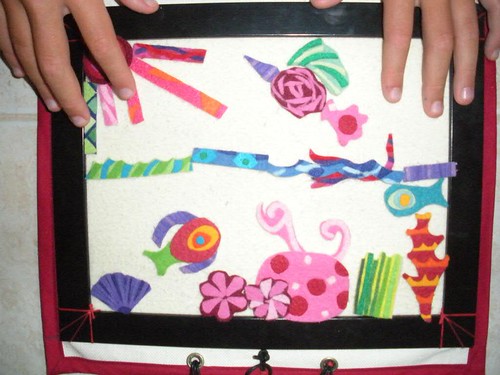
  • While they still enjoy their digi-toys, their favorite things of late have become coconuts, seashells, strange fruits, a feltboard—or activities that aren’t “things” at all.

DSCN0956

This blossoming has its poignant moments; it happens so fast, a doting parent can begin to feel obsolete. Like a slap to the head, it hit me yesterday that AllBoy will likely be leaving the house in just over six years. That’s too soon. Better start scheming another Sabbatical—before it’s too late.

Only rarely can I offer them a stretch of time to grow like this BreakAway. But how sweet it is to see that their minds, bodies, and hearts are expanding in ways that only such experiences can provide.

Greetings from Grenada

Posted on: Saturday, January 31st, 2009
Posted in: Travelog, 4th Stop: Grenada, Latest Trip | Leave a comment
Getting to Grenada is not easy. Maybe that’s why tourists are relatively rare, and an “undiscovered” label still sticks in most guidebooks. That’s all good by me. We came here, 12 degrees north of the equator and not far from Venzuela and Trinidad, to find out if some authentic, old-world Caribbean still thrives. 

3252524305_dd7dd5bfd7
Good news:  It’s alive.  The BreakAway timetable bestows us with about 27 days here, so much exploration lies ahead.  But the early impressions are pleasing and promising… 

  • It’s about the people.  Every reference source raves about the friendly, happy people.  Maybe all 110,000 of them aren’t, but most I’ve met so far sure are. 

Study in Orange, Part 2

  • They’re landholders.  Grenadians love their land, and most of them own some.  That does a lot to keep pride up, crime down, standards high, and poverty low. 
  • Size matters.  At 118 square miles of volcanic steepness, this place is expansive by island standards.  That gives it some added depth; the locals call inland “the country.” 

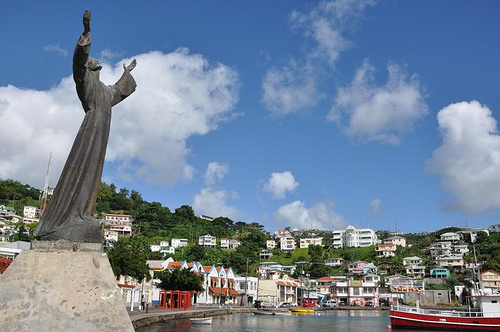
Grenada Town

  • History.  Talk about color!  This gem has had tribes fighting over it since the Arawaks and Carabs, then the French and Brits, and not long ago, a group of Cubans and Soviets. 
  • The revolution.  Now, and for all of 35 years, this nation is independent!  There WAS that nine-year period of fledgling socialism, that led to a short but bloody revolution, that led to a short but successful 1983 intervention by US and others.  But since then, government has been quite stable, peaceful, and democratic here.  Folks love to talk (and chuckle) about it, and may mention acquaintances who were part of the drama. 
  • Hurricane wreckage.  This island is allegedly off the main path and had seen no major storm since 1955.  Oblivious to that, Ivan tore through here only five years ago, crushing most of the island into a dreadful disaster.  Though some destruction is still evident, the rebuild has been impressive and inspiring. 

Hurricane Ivan Evidence

  • Education.  Most Americans wouldn’t want to send their kids to school in the Caribbean–with one exception:  St. George’s University has an oceanfront campus, a respectable medical school, a high-school program for residents, and 5,000 lucky students from all corners of the world. 
  • Natural beauty.  Find it anywhere and everywhere here.  Diversity too, from inland lakes, rivers, and waterfalls, to craggy cliffs, rural fields, and 3-mile long beaches.
  • Quaintness.  They take their old-world Caribbean vernacular seriously.  Fat new-money homes are rare, as are sprawling resorts.  Instead, owner-occupied, charming little venues dot the waterside.  And houses come in rainbows of colors—though the red-roof tradition carries on. 

St. George's, Granada

  • Art.  Batik is big.  Face carvings and masks tell stories.  And bright paintings hang all over.  There’s even a thriving arts and crafts market.  It’s as if Grenadians are trying to outdo each other sometimes. 

Faces

  • Safety.  Practice good travel hygiene, of course.  But after that, this place has a rep that gives little to worry about.  I saw two uniformed police dancing at a packed event.  And one white local told of being the lone whitey entering a big cricket match.  When some teens with ‘tude started harassing him, a crowd of older natives (all strangers) surrounded the bad boys and scolded them long and hard. 
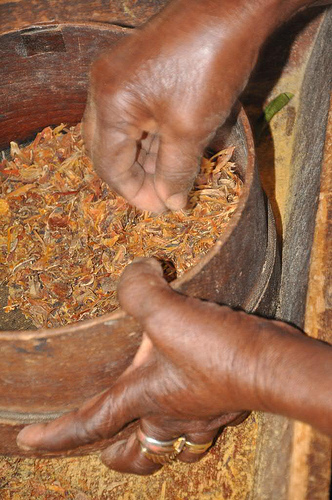
  • Food.  Necessity is the mother of all big gardens.  But they eat well and cheap here, thanks to plentiful fisheries, rich volcanic soil with organic gardens, and generous, tasty traditions.  Known as the “spice island,” Grenada grows one-third of the world’s nutmeg, and much of its clove, cinnamon, and more. 

Spice Plantation


  • Tourism.  The revolution didn’t help.  The hurricane hurt.  Two charter airlines just went bankrupt.  And remoteness rarely draws.  There’s just enough tourism here to boost the economy, but not so much that it’s choking the locals. 

Somewhere Over the Cruiseship

  • Culture.  It’s different—more diverse—down here.  English influences outweigh America’s. There are hints of South American, India, and Asia.  It’s a melting pot, a spicy stew.  But for sure the main influence around here remains authentic Caribbean, no:  uniquely Grenadian.  
  • Partiology.  They call it “limin,” and make a science of it.  Students, locals, tourists:  It don’t matter.  Bars, beaches, and resorts can become one rollicking party, any time of the day or night.  Bar closing time:  Until…

3236608289_53ee2ab4bd

  • God Bless Our Nation.  So hangs a sign, in the flag colors, thoughout the island.  Manners matter.  Island and tourist dress code is not only in effect, but debated in the papers.  It can feel conservative to Americans, but these little courtesies stand for respect, pride, tradition, and preservation of something sacred.  God Bless Grenada! 
Flag of Grenada
 

To Grenada: 3 Vessels, 2 Seasick,1 Exciting Day

Posted on: Monday, January 26th, 2009
Posted in: Travelog, In Transit, Latest Trip | 4 comments

The alarm chirped at 5:55, long before sunrise, but this insomniac had already been stirring for hours.  So we arose fast, snarfed food, and began this Sabbatical’s most ambitious day of travel. Taxi Calvin to downtown.  Friendship Rose schooner to Tobago Cays.  Water taxi to Petit Martinique.  Ferry to Grenada.  Taxi to our next home. 

3237443166_23ffc90fa4-1

Taxi Calvin was uncustomarily late.  But after our requisite (and passionate) dispute (that he “won”) a few days earlier, this was a predictable rebuff.  Yet he got us to port, whereupon we and our large luggage boarded the stunning old schooner and enjoyed the generous continental breakfast that was awaiting. 

  • The Promises of Sail:  Get Bliss or Seasick

The trip exceeded expectations of beauty, service, and comfort—for the first half-hour or so.  Then the dark clouds began to roll in.  It rained.  Hard and long.  Stinging and cold.  Captain Lewis had all sails up and engines on and tried every maneuver, but the clouds followed us like pesky dogs. 

Stormy Seas Ahead

Elegant white pillows filled like wet sponges.  The deck turned into a skating rink. Crew donned raingear while the rest of us had none.  (Note to posh boat:  Keep cheapo ponchos for your customers, please.) 

The mammoth vessel had space to burn, but only two places to try stay dry:  Under a little canopy on deck; or in the cabin below.  I avoid cabins in choppy seas—in that way that I avoid puking when possible.  But my family descended into the dry but perilous purgatory. 

For a while, that is.   Then, naturally, they came up and started belly-aching.  My sick 5-year-old, CurlyGirl, collapsed on my lap as I sat under a corner of the canopy on the hard, drenched deck.

Seasickness Happens

And there she stayed for, oh, an eternity or two.  My squished body went from uncomfortable to miserable.  But she fell into a shaky sleep, after much moaning and whining, and a few hours later woke up giggling about a few “little burps.”  In no time, she was ambling her way back to stability—and I was happily munching more ibuprofen. 

That was a big, messy bullet to dodge, as our 11-hour travel day was mostly on boats.  In the worst-case-scenario fearbook, she could have been green and groaning all day. 

  • A Day of Island Hopping

Thanks to motor-sailing in uncooperative but heavy winds, (so loud, so unromantic), we made it “on time” to the Tobago Keys—a surreal preserve of tiny, beachy islands plopped atop a shallow reef and loved to near-death by 100s of yachts.  A dinghy took us to a tiny secluded islet.  A place where you can stand on a strip of sand, face out, and see nothing but uninhabited cays. 

Leaving the Friendship Rose

The trip was off to a so-so start, but that moment provided the payoff.  This was the edge of the earth.  A place where simply standing makes your spine tingle.  A snorkel revealed dozens of endangered hawksbill turtles; even CurlyGirl saw several and felt the enchantment.  Then we were rushed back to the boat for lunch, as we’d soon be picked up by a water taxi right here, in the middle of nowhere. 

  • Island Time Knows 2 Speeds

The thing about “island time” is that it’s very digital.  Usually it’s on “LOW”—slow and sluggish; don’t even try to rush things or people and powers conspire to gradually assimilate you.  But when someone in charge of your destiny gets a bug up their butt, and there are a lot of bugs in the tropics, they get ants in the pants and make you dance. 

So it was when our dinghy driver asked us if we wanted to snorkel some more, a mere rhetorical question.  Because then, he abruptly shifted to “HIGH” and started barking at us to get our stuff and get back to the Friendship Rose.  Speedi (the taxi driver) had arrived.  Very early.  But he too was on “HIGH.” Our Water Taxi

Indeed, there floating about 12 feet off the stern of the FR was a sorry tub painted pink, and one sunglassed race-driver with a hand on the ample motor.  Back on the Rose, I pulled aside Captain Matt (an acquaintance from long ago that we did NOT know would be on the boat, but that’s another story), “Isn’t Speedi early?”

Matt confided, “Yes, and that’s unusual.  He must want a little something to eat.”  And sure enough, Speedi boarded after us, shook our hands, and got a bonus lunc,.  As we gobbled (a yummy chicken dish with Calypso sauce) and gabbed, “island time” hit the “HIGH” button again, and the crew started throwing our luggage down to Speedi’s boat.  Everyone started hollering commands about needing to set off before the dinghy got to the boat with the rest of the remaining, and staying, passengers. 

Captain Matt did some quick Q&A and PR work on our behalf with Speedi, some of which went something like this…

M:  Speedi, do you have a tarp if it rains?  These people have electronics gear.

S:  You doan need to worry yo’seff about no rain!

M:  I’m not worried, Speedi.  They asked me so I’m asking you.

S:  (Quick glance at sky)…I doan tink it gwine rain.  If it rain, we figga some-tin out. 

M:  Well, we have some large garbage sacks…

S:  Yeah-yeah-yeah.  Give me sum dem big socks, mon. 

Speedi moved full-speed at distributing our stuff and our persons for weight and mind control.  My “seat” assignment was beside clingy CurlyGirl, and on the edge of the boat—ensuring that I would endure nonstop ocean spray plus the sensation that I was about to fall off. 

  • High Seas Ahead

Our new, now-rosy friends on the Friendship Rose waved with one hand (while the other clutched drinks)—just like in the movies—while Speedi hit the motor and we lurched into the seas.  When I enquired about the gnarly conditions, he shouted, “Yeah, it does be pretty choppy out dere today, but I does have some life preservers.”  I’m sure he did, though I couldn’t say where. 

But away we went, into the rocking and roiling blue abyss. 

To be fair, we took air only five or ten times.  The kids loved it, sometimes.  I found it frightful and delightful, and kept reminding myself that since I signed up for this at great cost, surely I could soak it all in and keep fear, if not seawater, at bay.  That worked mostly, though less so when AllBoy would thrust his arms in the air as if we were riding a roller-coaster.  “Boy Overboard!” was not on this itinerary! 

Speedi spent most of the time selling us, his captive audience, on taking a full day trip with him to study all the sights we were buzzing by—bellowing in harmony with his big motor. 

  • The World’s Tiniest Port?

Finally, we slowed, and started entering the world’s smallest port, Union Island.  Speedi babbled about this taking “maybe 3, maybe 5” minutes, which I know means add a zero to both numbers and start to pray.  I asked if this was the customs stop where we’d have to pay a fee.  He replied, “Yes!  $68 EC”—different from what others had quoted—but added, “Maybe since you wid me I git you outa dat money today.”  My eyes rolled, both from the rough ride and his expected comment.

Frozen-in-time (or was it ice and rum?) yachties watched us drift in, while the little boys fishing on the dock stopped to stare.  Speedy tied up loosely to a slivery dock, left all our stuff, and commanded, “Follow me.”  Island time was still on “HIGH.”  We scampered for several blocks on a muddy road—past dead shops, tiny bars, a neglected “Yacht Club,” and shanties. 

Customs This Way

Once inside the world’s smallest airport, it was clear that we would undergo some sort of customs thing here, as there was an 8” x 10” yellowed, ripped piece of paper on a door that said “Customs In Here.”  But that’s another story, too, this surreal customs encounter. 

At any rate, and by that I mean at least 30-50 minutes (and only a few “Please dear Gods…”) later, we emerged—having gradually been granted permission to leave the north end of the Caribbean and enter the south end.  An invisible line in the sand and surf that says:  Good-bye, St. Vincent Grenadines; Hello, Grenada Grenadines. 

Best of all, they waived the fee.  Speedi gave himself the credit, but it didn’t hurt that the kind lady was smitten by our rare, blonde, little CurlyGirl. 

  • Riding the Waves

Speedi pushed us back into his giant floating bathtub, and off we returned to the wild blue yonder for more thrills and chills, as waves and swells grew to several feet and Speedi zipped around them like an Olympic bobsledder, or else over them like an Olympic ski-jumper.

As with the first leg, the middle of the voyage was the worst—once protection from islands and reefs disappeared.  We watched our luggage take a sea bath.  Sunglasses became salt-glasses.  And we passed some surreal sights:  Abandoned homes built on remote, unreachable precipices; bedroom-size islands with one palapa and a chaise lounge; peninsulas piled high with precious conch shells, some ancient gray, some fresh pink. 

Happy Island

Who ARE these people!?!  I kept wondering.  What do they “do” for a living?  Or are they on a secret, perma-BreakAway?  Before I could figure all that out, Speedi mercifully slowed toward a dock on Petit Martinique, population 1,000 (as if!).  Thanks to Island Time on “HIGH,” we had arrived an hour and 15 minutes early.  Go figure. 

All About Petit Martinique

PM (as its called down here) had not a lot of “there” there.  So AllBoy went exploring a dirty beach with 1000s of forgotten conch chunks.  CurlyGirl needed a bathroom, which set off an lengthy expedition.  And I rested on wet baggage and watched this little world go by—a few loud fishermen coming in, a curious boy not in school, and some Bible-toting ladies sauntering off to do the Lord’s Work. 

  • Ferrying the Final Leg

Finally, the impressive Osprey Express tooted its arrival and came slamming into the dock, looking out of place on this Gilliganesque island.  At most, 5 or 10 of us boarded.  My children chose the air-conditioned indoor area. Partner and I took choice seats on the deck. Leaving Petit Martinique

One more stop before Grenada:  Carriacou.  This time, 100 enthused folks piled on, including a rowdy cricket team celebrating victory (or loss), a dozen international tourists, and one large motorcycle.  The ride was fast and smooth, with myriad, mysterious flying fish soaring, veering, and skipping over our wake like so many waverunners. 

Speaking of, two rambunctious waverunners DID soon find us, and join the flying fish in riding the waves.  The world being a small place, they occasionally rode right up to the deck and had conversations with friends on board.  They all but passed along beers. 

The emerald, craggy west coast of Grenada provided entertainment.  And by the time the sun was setting, we pulled into the handsome port of St. George’s. Grenada Welcomes You

Taxis fought over us, almost literally, and the one who won was yelling, “STOOPID!  STOOPID!” to the loser (who was yelling more and shouting much naughtier phrases) until we drove out of sight.  (He kept his language G-rated on account of our children.)  As usual, this driver sold us nonstop on his island tour while repeatedly pushing biz cards into my palm. 

Then we checked into our little resort, a lovely and refreshingly sleepy place.  Land felt good, but that wavy sensation took hours to subside. 

After a day like that, the buzz wears off slowly.  So unpacking clothes and gear and taking an enthusiastic swim in the cool saltwater infinity pool were good ways to wind down.  Overpriced Sauvignon Blanc was room-serviced to our villa.  The restaurant took its sweet, “LOW” Island Time to feed us supper.  And we toasted our adventurous day. 

We did it.  We’re drained, but still in one piece. 

Grenada looks grand.  And we have about 27 days to make ourselves at home.